Monday, February 28, 2011

Amazing Meetings

The number of patients in the world with ALS is very small as compared with other diseases. ALS patients are told they have 2-5 years to live and so the number of patients that pass in less than 5 years, based statistically, is close to 80%. In other words, there aren't many of us around long enough to make a difference. In almost every case I have witnessed, patients who exceed these life expectations have made significant impacts in their community or in the lives of others. It seems as though, if you have more time, you come to grips with your own fate and allow yourself to reach out to others.

Being blessed with a slow progression and the associated extended years is one thing, but PALS who reach out and are able to make significant impacts within the first year or two are truly amazing. Imagine that your disease is progressing at a rate that is making it difficult for you to do just about everything and on top of that, you add all of the responsibilities of coordinating fundraisers, attending support groups, being the chairman on multiple boards and taking the time to chat with other patients; while all the while, planning for your own progression on a daily basis.

A few days ago, I had the opportunity to meet one of these PALS, AUGIE NIETO. IMG_1323Augie and his wife Lynn went through some very tough times in the first six months after he was diagnosed in March 2005 including Augie attempting to take his own life through an overdose of pills. At the time of Augie's diagnosis they had 15 and 18 year old son's. They have persevered and have now raised close to $30 million and have contributed almost as much time and money personally.

My sister was able to get us in to an exclusive event being held annually by the YPO (Young Presidents Organization). Luckily, this year it was in Denver. This is an event where George Bush was scheduled to speak, Julian Assange spoke and many other very successful business leaders (Julian omitted). Augie Nieto of course, being one of those successful business leaders with his success inventing the Life Cycle and subsequently the Life Fitness empire.IMG_1327Augie has come from a dark, desperate, fear that many ALS patients and their families have known in the beginning, to one of being a hero, a role model and one of the foremost fundraisers for ALS in the past five years. ( including MDA ALS site - Augie's Quest & ALS TDI )

Augie and Lynn's story was very close to our heart of course, but it was good to see an entire room exposed to “A day in the life” of an advanced ALS patient for the very first time. A room of people that has the financial backing to make a difference one day. Lynn did most of the speaking and Augie used his computer to give us his funny "Top 10 reasons it's good to have ALS" in the Dave Letterman style. They both were very adamant that the use of humor to get through each day was crucial to them. And dark humor at that - and we couldn't agree more. At the end of the talk, Julie, my sister and I found ourselves to be the last people in the room still chatting with Augie and getting a tour of his highly customized Dynavox daily operations software. (After all, he is on the board of Dynavox as well)

#10 - The fatter you are, the longer you live (B.O.B.)
#9 - You can give advice to you kids and they might even listen.
#8 - You get to take medical marijuana.
#7 - You can go to a strip club, have a lap dance, and not violate the "no hands" policy.
#6 - You never have to buy new shoes.
#5 - You can have bondage sex without straps… You just lay there.
#4 - You can hire out as a carpool dummy.
#3 - You can ask a woman to unzip your fly.
#2 - You can take a shower with other women and your wife won't complain.

And the #1 reason that it is good to have ALS is:

#1 - You get to experience the love and generosity of your family and friends-every day!

Again, thank you very much to Augie and Lynn for their time and a wonderful talk. I feel fortunate to have seen Augie, because Lynn mentioned that it may be the last time they fly. They came with so much equipment, caregivers and bags upon bags of tools/supplies that it may not be feasible again.

Saturday, January 29, 2011

1955th Day

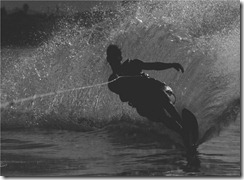
It's been 1955 days since we heard the bad news. September 22, 2005, yet I continue to defy all odds by still being able to walk and still being able to dictate via speech software. (Albeit, somewhat slurred at times) It's been 4 1/2 years since I've been able to water ski (this was me on the SDSU ski team in San Diego). But, I was able to snow ski as recently as last March 2010. Both were some of my favorite things to do. I considered skiing last month, but I'm afraid that the weakness in my legs may cause me to fall. Being injured at this point, I doubt my body would ever recover or be able to rebuild any muscle loss after a cast came off. It's just not worth it. I started skiing at age 3, so I got a good 40 years in and never missed a season. Plus, if I were to even tip over, I would need people to help me even stand back up with all that gear.
Roger water skiing Roger snowmass 02-2007-b
Sports are one thing… However, not being able to play the drums for the past five years has been one of the hardest challenges. I enjoyed it so much. Not only was it good cardio exercise when I would practice for hours at a time, it was an escape and a time to enjoy playing along with my favorite music. I have enjoyed watching my older son become very good at playing. It has allowed me to still play vicariously in my mind Through him. CBS-Home Taping Pro Pics-66 CBS-Home Taping Pro Pics-21
Luckily, I was never Someone who lacked hobbies or things to do. Being "bored" was a 5 letter word in Our house. Lately, I keep myself busy by working on the computer, which is a hobby of mine. I have all the tools necessary to help others through remote support and am looking for people to contact me who need help setting up parental controls, network monitoring for kids, antivirus/malware software installation, program training or fixing any general problems people may have on Windows or Macintosh.
38409_1497663835165_1041205567_1479970_5204182_n
My other favorite thing to do was Amateur astronomy & astrophotography with all of my Telescope gear…
DSC03848DSC00484_finished-best3-filtered frames-Saturn4-92x1-1-28-05 New SaturnBest SW limb of moon_9-28-04Copy of 11-10-07_Rog_Astros-Comet HolmesFirstSun-1-29-05cOrionNeb-Mosaic-1-15-05-childs-LX200-8-Rotated Peocessed-coloredMoon Mosaic 2-28-04M51 Whirlpool galaxy -Roger
ALSO, driving my Porsche up in the mountains which I’ve since had to sell and stop driving all together..
DSC08563Rog Porsche 4-20-2008 7-38-42
LIFE IS SO AWESOME WITH ALL THE THINGS GOD LETS US HAVE, LIKE MY FAMILY!!!
IMG_3423
.

Tuesday, December 14, 2010

Why Can't They Just All Get along?

For years now. I have not been able to understand why ALSA, MDA, ALS TDI and a handful of other support/research groups have not been able to get along and coordinate their support and "primarily" research. They each collect their own money, have their own fundraisers create their own research centers and, while this seems fine, at least you would expect them all to share information. This is not the case. Recently I found out that ALS TDI one of the leading research centers for specifically ALS in the world has not received one penny from ALSA. Being that ALSA is one of the #1 fund raiser in the United States, if not second with MDA, I find it hard to believe that none of their resources are directed toward ALS TDI.

As a patient. I find this extremely frustrating and using examples from other diseases, I don't really understand the reasoning or politics behind it. Cancer research centers cross communicate, Parkinson's, Alzheimer's and multiple sclerosis groups seem to share at least basic knowledge of trials and drug candidates. I also became aware of a Facebook group which has the sole mission of boycotting ALSA, National due to its inability to use funds for "significant" research. Don't get me wrong, ALSA on the local level is extremely helpful and useful when it comes to patient and caregiver support, but of course they're not involved with research. Our family receives tremendous support from our local Rocky Mountains Chapter.

This all became very apparent to me in the preceding months before our CBS special, Live for the Moment (LF TM), which aired on January 28, 2010. In order to make the most out of the show and its slot on primetime Thursday night CBS television, I began working very hard to make ALS TDI, ALSA and MDA aware of it. I was very successful in getting buy-in from ALS TDI and their full support to put the show's logo on their website. ALSA national also was very eager to promote the show and had a write up and logo on their front page as well. It was a little bit more difficult with MDA due to the way it was handled between their representative and the CBS. (A long story). In the many writeups and comments from the ALS community that followed, ALSA was criticized for not buying airtime just after the show as a public awareness opportunity and a chance to point people to websites where they could donate time and money.

I'm not quite sure what can be done in order to encourage the primary groups to engage one another more frequently and at a greater depth. The willingness also doesn't go both ways equally. What I mean is, ALS TDI is extremely willing to work with ALSA and MDA, and in the case of MDA, they have the Augie's Quest initiative, which does donate considerable funds to ALS TDI in Boston, Massachusetts. However, ALSA seems to be an organization that is closed and operating primarily within its own boundaries. If this is not the case, I have failed to find evidence of it on their prep site.

Some groups focus on caregiver assistance and equipment for patients along with the fundraisers and awareness events to raise money for the use activities. Other groups focus solely on therapeutics such as the Therapy Development Institute. MDA and ALSA are organizations that try to do both and it would be far more effective to funnel all funding into, one highly capable organization. Maybe the funding would reach such a level that the government would take notice and match or contribute additional funds. There are multiple facets to this philosophy such as, if multiple centers are doing the research, then you have multiple approaches and different thought processes going on. But no one seems to have enough money to make headway on their own. Anyway, maybe if all of the research groups were to be housed under one roof and pooled all of the money, then the multiple philosophies and drug approaches would be combined with uninhibited communication between the groups.

Yeah, like that would ever happen in my lifetime…
I would love to hear your comments and read any thoughts you have on this topic.

Sunday, December 05, 2010

Thoughts on Lyme disease “or” ALS

I wanted to put my thoughts on this matter on the record.  Before you read too far, let me be clear that I do not believe there are the links that we are led to believe by so many postings on the Internet. I recently posted a video of leg fasciculations on YouTube here.  I received multiple feedbacks as well as many comments about whether or not it could be Lyme disease and not ALS.  In fact, there is an entire movement out there that is convinced that many ALS cases are in fact untreated Lyme or "chronic Lyme".  I have read about people taking large dose intravenous antibiotics (ceftriaxone as talked about in the videos below) in order to combat this. I have first hand knowledge on this (more on that later).  There is also a move to have people believe that various unproven health and "antiaging/nuerological" health supplements sold by many MLM outfits will have you cured and your symptoms reversed lickety-split. Be very wary people.

The majority of contacts I have received always seem to include a segment on how inaccurate and incapable blood tests are at detecting Lyme disease. While it may be true that standard blood tests are inadequate, my interest wanes quickly as I discover that they want me to take a certain supplement, call a certain Dr. or begin some miracle therapy.  I myself, had my blood work done by the premier lab just for this type of test. After also being pulled into this "Lyme" lie/scam/false belief... etc., I had heard of David Martz, MD through a friend and had watched his videos online.  A close friend of mine, also with ALS, was contacted by someone in Texas who had worked with Dr. Martz and his staff out of Creek Trail Medical Clinic in Colorado Springs.  Dr. Martz has since retired and Dr. William Harvey has taken over, at least as of 1 1/2 years ago.
About Lyme

Part 1 - Theory that ALS and other motor neuron diseases are linked to Lyme disease


Part 2 - ALS, Multiple Sclerosis, Alzheimer's and theorized links with Lyme disease

Their theory was also that some bacteria or disease that could be treated with powerful, high dose antibiotics delivered intravenously.  Before treatment, however, both my friend and I had blood drawn and sent off to IGeneX, Inc.  By the way, I also had blood tested at the Houston Medical Center as well as the University of Colorado Medical Center.  Which were also both negative for Lyme. Watch the videos in this post to form your opinion.
With regard to high dose antibiotics delivered intravenously;
…….tbf

Wednesday, October 13, 2010

Spain Oddities

Place: Sitges, south of Barcelona Spain
Near the Mediterranean seaside town Cathedral

Date: June 2009

Connor, next to the world's largest green Converse hightop.

It's taking up 2 parking spots as compared to the silver car behind it.

Strange art can be seen around the world.
Posted by Picasa

Thursday, September 23, 2010

Some Astronomy & Fun Happenings

After a few weeks of fairly low activity, a lot of fun things have recently happened.

Some Astronomy Fun:

Connor and I when out for a viewing session of Jupiter as it makes its closest approach this September 2010 until the year 2022. I had sold my larger Meade LX 200 GPS scope approximately 2 years ago, but kept the smaller Meade ETX 105 for easier viewing sessions and eventually something to pass on to Connor and Brandon. I hadn't brought it out in over a year and even thought about selling it. (I've recently been wanting to buy a Macintosh)
Well, it was late, but we decided to pull it out and set it up at about 9:30 PM. Julie wasn't thrilled that was keeping Connor until 1130, but hey, has been over a year. The moon was almost full and as sparse clouds slowly passed by the crystal-clear sky, Jupiter was out in all its glory. It was almost 75°, a gentle breeze kept any bugs away and it was perfect.

Connor and I have seen Jupiter many times and I have even spent many hours imaging Jupiter with both the 10 inch scope and the 5 inch scope.

jupiterjupiter meade etx105

My neighbor came over and it was his first time looking through a telescope, ever. I think he enjoyed it very much and was also amazed at the detail that was visible on the almost full moon. I mentioned, of course, that the real in viewing the moon is when it is first quarter or less. All four Gallery in satellites were clearly visible as shown in the astronomy program graphic below.

1482Jupiter 

And here is a picture I took of Jupiter back in 2004 And the rest of my astronomy hobby Photo album!

Rogers-Jupiter-Compare

Wednesday, September 22, 2010

More research on ALS

Get enough to eat and drink

(credit to another ALS patients blog)

Most people find a gastrostomy tube is much more comfortable and easy to use than they thought it would be.
Malnutrition, present in 16 percent to 50 percent of people with ALS, is a predictor for worsened survival, according to a study published in 2000. The main cause of malnutrition in ALS is swallowing dysfunction, resulting from paralysis of muscles involved in swallowing, but weakness of the muscles involved in chewing food also contributes, as does a higher than normal metabolic rate of uncertain origin in this disease. (My metabolism has always been skyhigh)

A vicious cycle can ensue, in which poor nutrition exacerbates weakness, and weakness in turn limits food and liquid intake.

Signs of insufficient intake of calories may be obvious, such as excessive and rapid weight loss. But for those who like an objective measurement, a body mass index (BMI) of less than 18.5 is considered a red flag. To calculate your BMI, go to www.nhlbisupport.com/bmi.

While you can still swallow and chew safely, take in foods and liquids that are dense in calories, such as high-calorie shakes and bars, and high-protein foods like meat, fish and eggs. Drink plenty of fluids to avoid dehydration. I try to eat high cholesterol meals as well as high caloric meals. I will discuss the high cholesterol portion of that statement later.

When eating and drinking are no longer safe because of fear of choking, or when eating a meal takes so long you become exhausted, it’s time to consider a gastrostomy, or PEG, tube. PEG stands for percutaneous endoscopic gastrostomy tube, which relates to how the tube is inserted. The end result of PEG tube insertion is a small tube that goes directly into the stomach from outside, not something that goes through the nose or down the throat.

Most people find it’s much more comfortable and easy to use than they thought it would be.

A very active online forum at www.als.net/forum is operated by the ALS Therapy Development Institute (an ALS research institute in Cambridge, Mass., supported by MDA) and provides a variety of opinions and experiences with the PEG tube and other aspects of ALS therapy.

From an anonymous ALS patients post: “Best thing I could have done! No more choking, no more dehydration, no more weight loss. ... When I got mine I was still walking and drinking normally but having trouble with food, and I’d lost 35 kilograms (77 pounds). It would be fair to say I was in denial, and it took a while for me to adjust to the idea of having limited food intake. Now I can’t believe I was so silly.”

Breathe well

Noninvasive ventilation can prolong life despite a decline in respiratory muscle function.
As the muscles involved in respiration — the diaphragm and the intercostals, which are between the ribs — weaken, it becomes harder and harder to move enough air in and out of the lungs. This is especially true when lying on one’s back, as the weight of the abdominal organs creates even more resistance for the weakened diaphragm. I haven't had problems breathing while on my back and my FVC is still at 85%, but I have noticed needing to take additional breaths during sentences.

In recent years, a large percentage of ALS patients have opted for “noninvasive ventilation,” or NIV, to help them with their breathing. NIV delivers air under pressure (with a normal percentage of oxygen, not an oxygen supplement) to the lungs via a face mask or mouthpiece.

A 2007 study showed starting NIV earlier prolongs survival better than starting it later, when respiratory function is worse. This study used 65 percent of normal forced vital capacity (the amount of air one can exhale after taking in a deep breath) as the dividing line between early and late intervention. People who started using NIV when their forced vital capacity was at least 65 percent survived an average of 329 days longer than those who started it when their FVC was lower than 65 percent. NIV can be used for as many hours of the day or night as the person wishes and can easily be taken on and off.

Although NIV may prolong life by months or even sometimes years, for indefinite survival with ALS, “invasive ventilation,” which means ventilation through a tracheostomy tube, is almost always required. A tracheostomy is a surgically created opening in the trachea. Not only the delivery route but the type of ventilation device used with it provides for more complete substitution for normal respiratory muscle function than does NIV.

Surprisingly few studies have followed the course of people with ALS who have opted for invasive ventilation. In fact, many studies use “death or tracheostomy” as an end point, implying that these are approximately equal. That, however, is certainly not the case, so it may be that following people with tracheostomy ventilation until death would take so long the study could not be wrapped up in a timely fashion.

A small study published in 2003 in the journal Neurology found that, out of 70 people with ALS in Tokyo who opted for tracheostomy ventilation, 33 survived more than five years on it. In that group were three people who lived for 10 years on tracheostomy ventilation and two who survived for 18 years. The most common cause of death was pneumonia, followed by cardiovascular disease.

The down sides of tracheostomy ventilation are that it requires respiratory care that poses a significant burden on family members or costs a great deal if professionals are hired to help, and that it may allow for prolonged survival even when all voluntary muscle movement has been entirely lost and even communication is difficult. Still, many people are happy with this option.

From an anonymous ALS patients post: “My wife decided to follow the doctor’s suggestion and get her trach early,” noted an ALS TDI Forum visitor in March. “It’s been over two months now, and it has made a huge difference. She looks 10 years younger, has good color, and hasn’t taken a nap since the procedure. She was on BiPAP about 17 hours a day before the procedure. Her oxygen saturation has been excellent. ... Caring for her can be a bit overwhelming at times, but it sure is a lot better than the alternative. We are convinced we made the right decision!”